- Small Dog Place Home
- Feeding
- Dog Food Company Claims
Dog Food Marketing Claims: What They Really Mean
By Janice Jones | Updated 2026
When you walk down the pet food aisle, it’s easy to feel overwhelmed.
Bright bags and shiny cans promise:
- Real chicken
- Farm-raised ingredients
- Life protection formulas
- Powerful antioxidants
- Smart blends
At first glance, these phrases sound impressive. But what do they actually mean?
In many cases, not very much.
Pet food marketing is designed to capture attention. While some claims are regulated, many are loosely defined or legally meaningless. Learning to separate marketing language from meaningful information is one of the most important skills a dog owner can develop.
Let’s look at some common dog food claims and what they really tell you.
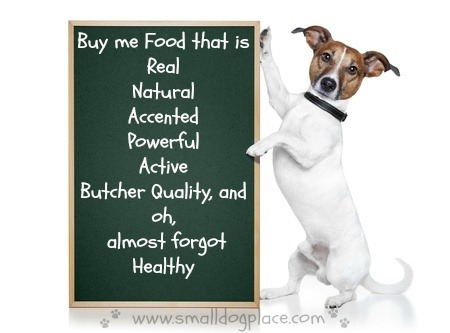

Ten Dog Food Company Claims
"Natural"
The word “natural” has a definition provided by the Association of American Feed Control Officials (AAFCO).
According to AAFCO, “natural” means the ingredient is derived from plant, animal, or mined sources and has not been chemically synthesized.
That sounds reassuring, but here’s what it does not mean:
- It does not mean higher quality.
- It does not mean organic.
- It does not mean human-grade.
- It does not guarantee superior sourcing.
In other words, “natural” is not a measure of nutritional value.
What to look for instead: Named animal proteins listed first in the ingredient panel and a clear AAFCO nutritional adequacy statement.
“Real Chicken” or “Real Lamb”
This phrase implies there might be fake chicken somewhere else.
There isn’t.
If chicken is listed as an ingredient, it is real chicken. The phrase is marketing emphasis, not a quality indicator.
The more important question is:
- Is chicken the first ingredient?
- Is it followed by multiple grain fillers?
- Is the protein percentage appropriate for your small dog’s needs?
“Real” is persuasive. It is not informative.
“Butcher Quality”
There is no standardized regulatory definition for “butcher quality.”
It sounds wholesome and traditional, but it has no measurable standard attached to it.
When you see this phrase, treat it as branding language rather than nutritional information.
“Healthy Fruits and Vegetables”
Many labels highlight blueberries, cranberries, spinach, or kale.
These ingredients may be present, but often in very small amounts.
If they appear after salt on the ingredient list, they likely make up less than 1% of the formula.
Small dogs do not require large quantities of fruit. While certain plant ingredients can contribute antioxidants or fiber, they should not distract from the primary focus: balanced protein, fat, and essential nutrients.
“Powerful Antioxidants”
Antioxidants help neutralize free radicals. That’s true.
But “powerful” has no measurable standard.
There is no rating scale for antioxidant strength on pet food packaging. This is descriptive language, not a defined claim.
A better question is whether the food meets complete and balanced standards for your dog’s life stage.
“Protein Focused”
Dogs are carnivores by ancestry, and protein is important. But “protein focused” is not a regulated term.
Look beyond the phrase and examine:
- Crude protein percentage
- Source of protein
- Whether protein comes primarily from animal sources or plant concentrates
Small dogs in particular benefit from highly digestible protein sources, not just impressive wording.
“Life Protection Formula”
This phrase suggests comprehensive health benefits.
However, it does not guarantee disease prevention or longevity.
No commercial food can promise lifelong protection. Good nutrition supports health, but it is only one piece of the puzzle that includes genetics, exercise, veterinary care, and environment.
“Smart Blend”
This is branding.
It does not indicate scientific superiority, specific ingredient ratios, or regulatory approval.
When in doubt, ignore vague phrases and go back to measurable information.
"Active Ingredients"
This term belongs more appropriately in pharmaceuticals than in pet food.
Dog food does not contain “active” versus “inactive” ingredients in the medical sense. Every ingredient contributes to the overall formula.
If a food highlights “active ingredients,” consider it marketing language.
“Accented With…”
When a label says “accented with vitamin-rich vegetables,” it often means a small inclusion designed to enhance appeal.
The word “accented” should signal that the ingredient is not a major nutritional component.
What Actually Matters on a Dog Food Label
Instead of focusing on marketing phrases, spend your energy on:
- The ingredient list (in order by weight)
- The guaranteed analysis
- The AAFCO nutritional adequacy statement
- The manufacturer’s transparency and quality control practices
If you want to understand pet food labeling more deeply, I highly recommend Dog Food Logic by Linda Case. It provides a science-based explanation of how pet food is formulated and marketed.
The Takeaway
Dog food companies operate in a competitive marketplace. Packaging must attract attention.
That doesn’t make every claim dishonest, but it does mean that many phrases are designed to sound reassuring rather than to provide measurable information.
As a former veterinary technician and long-time small dog owner, I have learned that the most informed dog owners are the ones who read beyond the front of the bag.
Your small dog deserves thoughtful nutrition decisions based on evidence, not advertising.
When you understand what matters, and what doesn’t choosing a food becomes much less confusing.
More About Janice (author and voice behind this site)
Janice Jones is a small dog specialist with a background in grooming, training, and animal behavior, combining hands-on breeding experience with degrees in psychology and counseling psychology. She has spent 50 years owning and caring for small dogs and 15 years breeding, with early work in veterinary hospitals and shelters, assisting with surgery, lab work, and client care. She shares practical advice at SmallDogPlace.com and across social platforms. A lifelong Shih Tzu enthusiast, she now works alongside her dogs, who rarely leave her side. Visit my " About Me " page for more details.
She is the creator of SmallDogPlace.com, MiracleShihTzu.com, and Smart-Knit-Crocheting.com. A lifelong Shih Tzu enthusiast, she now works alongside her dogs, who rarely leave her side.

Free Monthly Newsletter
Sign Up for Our Free Newsletter and get our Free Gift to You.
my E-book, The Top 10 Mistakes People Make When Choosing a Dog (and how to avoid them)