- Small Dog Place Home
- Feeding
- Free Feeding vs. Scheduled Feeding
Free Feeding vs Scheduled Feeding for Dogs: Which Is Better for Small Breeds?
By Janice Jones, Last Updated February 2026
Should you leave food out all day for your dog, or serve meals at specific times?
Few topics in dog care spark stronger opinions. Some insist that free feeding leads to overweight, disobedient dogs. Others argue that strict meal schedules create stress or food guarding.
The reality is much less dramatic.
Both free feeding and scheduled feeding can work. The key is understanding your individual dog — especially if you own a toy or small breed — and making decisions based on health, behavior, and practicality rather than debate.
This article reflects both current veterinary recommendations and my experience as a former veterinary technician and long-time small breed owner and breeder.
Let’s look at what actually matters.
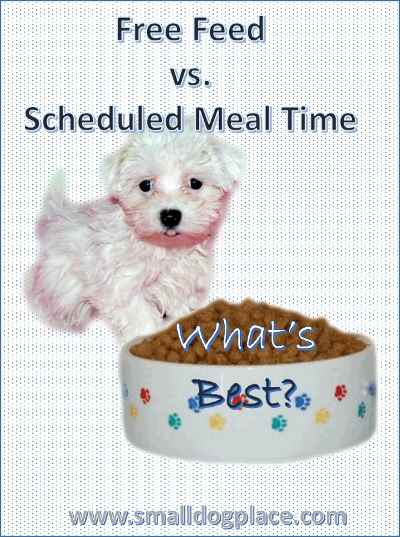

What Is Free Feeding?
Free feeding means leaving dry food available at all times so your dog can eat whenever they choose.
Owners may:
- Keep a bowl filled throughout the day
- Use a gravity feeder
- Top off food as it’s eaten
Free feeding is only appropriate for dry kibble. Raw, canned, or home-cooked diets should not be left out due to spoilage and bacterial growth.
At its core, free feeding allows the dog to regulate intake naturally.
Some dogs do this beautifully. Others do not.
What Is Scheduled Feeding?
Scheduled feeding means offering measured meals at specific times of day.
Typically:
- Puppies eat three meals daily
- Adolescents and adults eat two meals daily
Food is offered for about 15–20 minutes. If the dog doesn’t eat, the bowl is removed until the next feeding time.
Water should always remain available.
This method allows owners to:
- Measure exact portions
- Monitor appetite
- Establish routine
For many households, this structure simplifies life.
What Do Veterinarians Recommend Today?
Most veterinarians lean toward scheduled feeding for adult dogs.
Why?
Because it allows:
- Better portion control
- Easier weight management
- Faster detection of appetite changes
- Clearer medication timing if needed
According to the Association for Pet Obesity Prevention, more than half of dogs in the United States are overweight or obese. That statistic alone explains why portion control has become a major focus in veterinary medicine.
That said, recommendations are not identical for every dog — particularly very small breeds and young puppies.
Pros and Cons of Scheduled Feeding
Pros
- Easier to control portions
- Lower risk of overeating
- Appetite changes are easier to detect
- Can simplify house-training in puppies
- Helps establish routine
Cons
- Requires consistency
- Less flexibility for unpredictable schedules
- Some dogs may eat too quickly
Scheduled feeding tends to work especially well in dogs that:
- Gain weight easily
- Live in multi-dog households
- Need strict calorie monitoring
Pros and Cons of Free Feeding
Pros
- Convenient for busy families
- Works well for natural grazers
- May support toy breed puppies prone to low blood sugar
- Reduces pressure for picky eaters
Cons
- Hard to measure intake
- Can lead to gradual weight gain
- Difficult in multi-dog homes
- Not compatible with perishable diets
Free feeding works best when a dog naturally regulates their intake and maintains ideal body condition without supervision.
Unfortunately, not all dogs have that skill.
Special Considerations for Small Breed Dogs
This is where general advice often falls short.
Small dogs are not simply “little versions” of large dogs. Their metabolism, stomach capacity, and energy reserves differ significantly.
Toy Breeds and Hypoglycemia
Very small breeds such as Chihuahuas, Yorkshire Terriers, Maltese, and other toy breeds are at higher risk for hypoglycemia — especially during puppyhood.
Why?
- Fast metabolism
- Small energy reserves
- High energy output relative to body size
Young toy breed puppies often require:
- Three to four small meals daily
- Close monitoring of energy levels
- Immediate feeding if lethargy occurs
In some cases, carefully supervised access to food during the day may help prevent blood sugar dips.
However, once growth stabilizes and the puppy matures, most transition well to structured meals.
Free feeding is sometimes helpful in the earliest stages — but rarely necessary long term.
Puppies vs Adult Small Dogs
Puppies
- Need frequent meals
- Burn calories rapidly
- Benefit from predictable routine
Adults
- Usually do well on two measured meals
- May gain weight if calories are not monitored
- Often require fewer calories after spay/neuter
A feeding method that works at 10 weeks may not be appropriate at 2 years.
Reassessment over time is important.
Multi-Dog Households
Free feeding rarely works well in homes with more than one dog.
Problems that arise:
- One dog overeats
- Another eats too little
- Resource guarding develops
- Competition increases anxiety
In multi-dog homes, scheduled feeding in separate areas is usually the safer and more controlled option.
Feeding and Medical Conditions
Some health conditions influence feeding method.
Diabetes
Dogs with diabetes benefit from consistent, timed meals that coordinate with insulin administration.
Pancreatitis
Dogs prone to pancreatitis often require controlled, low-fat diets served in measured amounts.
Gastrointestinal disorders
Smaller, more frequent meals may be recommended.
Whenever medical issues are involved, feeding becomes part of treatment, not just routine.
Does Free Feeding Cause Obesity?
Free feeding does not automatically cause obesity.
Overfeeding causes obesity.
However, free feeding makes it harder to notice slow, creeping weight gain.
Dogs who:
- Love food intensely
- Are bored
- Have low activity levels
- Were bred for food drive are more likely to overeat when food is constantly available.
A healthy dog should have:
- A visible waist when viewed from above
- A tucked abdomen when viewed from the side
- Ribs that are easily felt but not prominently visible
If these landmarks disappear, calorie control, not philosophy, needs attention.
How to Tell if Your Dog Is Being Overfed
No matter which feeding method you choose, your dog’s body condition should guide you.
- A healthy small dog should have:
- A visible waist when viewed from above
- A gentle abdominal tuck when viewed from the side
- Ribs that can be felt easily but not seen prominently
If your dog’s waist disappears or you have to press firmly to feel the ribs, it’s time to reassess portion size, not necessarily the feeding philosophy.
Weight gain in small dogs can happen gradually and quietly. A gain of just one or two pounds in a ten-pound dog is significant.
The scale matters, but body shape matters more.
Does Scheduled Feeding Prevent Behavior Problems?
Years ago, some trainers suggested that controlling food reinforced leadership or dominance.
Modern behavioral science does not support dominance-based feeding theories.
Food aggression is more commonly linked to:
- Anxiety
- Resource insecurity
- Competition
- Genetics
- Early life experiences
Neither free feeding nor scheduled feeding guarantees behavioral outcomes.
Calm routines, consistency, and adequate nutrition matter far more.
What About Picky Eaters?
Some dogs appear picky but are simply grazing personalities.
Free feeding can work for these dogs, if weight remains stable.
However, in many cases, “picky” behavior improves when:
- Meals are offered on schedule
- Food is removed after 15–20 minutes
- Treats are reduced between meals
- Structure often encourages appetite regulation.
How Many Times a Day Should a Small Dog Eat?
General guideline:
- Toy breed puppies: 3–4 meals daily
- Small breed puppies: 3 meals daily
- Adult small dogs: 2 meals daily
- Seniors: 2 smaller meals often work best
Dogs prone to hypoglycemia may need more frequent feeding.
Dogs prone to obesity may benefit from precise calorie measurement rather than grazing.
Spay/Neuter and Metabolism Changes
After spay or neuter surgery, many dogs experience a shift in metabolism.
Caloric needs may decrease by as much as 20–30%.
If your dog was free fed before surgery and begins gaining weight afterward, structured portion control may become necessary.
This is one of the most common times owners need to reassess feeding style.
Activity Level and Caloric Needs
Not all small dogs burn calories the same way.
An active terrier who runs daily has very different needs than a quiet companion dog who spends most of the day indoors.
Seasonal changes can also influence intake. Some dogs eat slightly more in colder months and slightly less during extreme heat.
Pay attention to patterns rather than rigid rules.
What About Senior Dogs?
As dogs age, activity levels often decrease.
- Many seniors benefit from:
- Smaller, measured meals
- Calorie adjustments
- Monitoring for dental discomfort
A senior who once maintained weight with free feeding may begin gaining weight later in life.
Reassessment is normal and responsible.
Lifestyle Matters Too
Your schedule matters.
A feeding method that:
- Causes daily stress
- Is impossible to maintain
- Creates constant worry is not sustainable.
If you work long hours and your small dog maintains healthy weight with free feeding, that may be perfectly acceptable.
If your dog gains weight easily, structured feeding may offer peace of mind.
The “best” method is the one that works consistently in your home.
My Professional Perspective
After decades living with small breeds, working in veterinary settings, breeding, and rescuing, I’ve seen both systems succeed and fail.
In general:
- Adult small dogs do best on two measured meals daily.
- Toy breed puppies may require more frequent access to food.
- Multi-dog homes benefit from scheduled feeding.
- Weight management should always guide the decision.
If your dog:
- Maintains ideal body condition
- Has steady energy
- Shows no anxiety around food
- Is thriving overall
- then your feeding method is likely appropriate.
Feeding should not be a source of constant stress for responsible owners.
Thoughtful management matters more than rigid ideology.
Frequently Asked Questions:
Is free feeding bad for dogs?
Is free feeding bad for dogs?
Free feeding is not inherently bad. It works well for some dogs but may lead to overeating in others. Monitoring body condition is key.
Do veterinarians recommend scheduled feeding?
Do veterinarians recommend scheduled feeding?
Most veterinarians recommend scheduled feeding for adult dogs because it improves portion control and allows easier monitoring of appetite.
Can free feeding cause obesity?
Can free feeding cause obesity?
Free feeding does not automatically cause obesity, but it can make portion control more difficult. Overfeeding — not feeding style — causes weight gain.
How many times a day should a small dog eat?
How many times a day should a small dog eat?
Most adult small dogs do well with two meals per day. Puppies generally need three meals daily, and toy breeds may need even more frequent feeding early in life.
Final Thoughts
Free feeding and scheduled feeding are tools — not moral positions.
The right choice depends on:
- Your dog’s metabolism
- Body condition
- Household structure
- Activity level
- Age
When you focus on health rather than debate, the answer often becomes clear.
Pay attention to your dog’s body and behavior. Adjust as needed. And remember, thoughtful, observant owners rarely go wrong.
References and Further Reading
Association for Pet Obesity Prevention (APOP)
Obesity Resources
American Veterinary Medical Association (AVMA)
General feeding guidance and pet care authority.
World Small Animal Veterinary Association (WSAVA)
Global nutrition guidelines.
Tufts University Cummings Veterinary Medical Center
Widely respected veterinary nutrition resource.
Cornell University College of Veterinary Medicine
Reliable educational content.
More About Janice (author and voice behind this site)
Janice Jones is a small dog specialist with a background in grooming, training, and animal behavior, combining hands-on breeding experience with degrees in psychology and counseling psychology. She has spent 50 years owning and caring for small dogs and 15 years breeding, with early work in veterinary hospitals and shelters, assisting with surgery, lab work, and client care. She shares practical advice at SmallDogPlace.com and across social platforms. A lifelong Shih Tzu enthusiast, she now works alongside her dogs, who rarely leave her side. Visit my " About Me " page for more details.
She is the creator of SmallDogPlace.com, MiracleShihTzu.com, and Smart-Knit-Crocheting.com. A lifelong Shih Tzu enthusiast, she now works alongside her dogs, who rarely leave her side.
Free Monthly Newsletter
Sign Up for Our Free Newsletter and get our Free Gift to You.
my E-book, The Top 10 Mistakes People Make When Choosing a Dog (and how to avoid them)