- Small Dog Place Home
- Health
- Progressive Retinal Atrophy
Progressive Retinal Atrophy (PRA) in Dogs
Progressive Retinal Atrophy by Janice Jones |Updated January 21, 2026
Progressive Retinal Atrophy (PRA) is a group of inherited eye disorders that affect the retina and gradually lead to vision loss in dogs. The condition is painless and typically progresses slowly over time.
This page explains what PRA is, how it affects vision, common signs to watch for, how the condition is diagnosed, and what owners can expect in the long term. While PRA cannot currently be cured, many affected dogs adapt well and continue to live full, comfortable lives.
 Progressive Retinal Atrophy has been identified as having occurred in the Tibetan Terrier among other small dog breeds.
Breeds Commonly Affected by PRA
Progressive Retinal Atrophy has been identified in many dog breeds, including several small and toy breeds. Some breeds are more commonly affected than others due to inherited genetic traits.
PRA has been documented in breeds such as the
Toy Poodle
Papillon
Tibetan Terrier
American Eskimo Dog
Chinese Crested
Miniature Schnauzer, among others.
Breed-specific risk varies depending on the type of PRA involved.
The Retina of the Eye
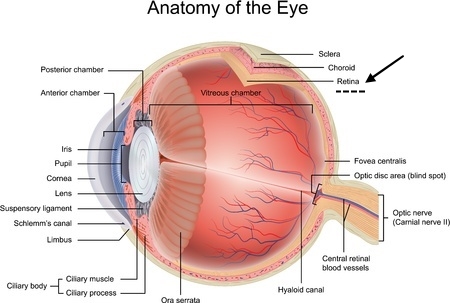 Notice Where the Retina of the Eye is located at the back of the eye structure.
The retina is located at the back of the eye, where it receives light entering the eye.
A chemical reaction there triggers a nerve impulse. That impulse passes through the optic nerve to the brain. Vision takes place in the brain.
As you can see, the eye is just an organ that collects light and focuses the light rays onto the retina. Without the work of the retina, light cannot be converted to real vision.
The retina contains two types of cells: the rods and the cones. Rods are involved in black-and-white or night vision. Cones are involved in day vision and color vision.
Progressive Retinal Atrophy affects either the rods alone or both rods and cones. As the rods begin to die, the dog’s vision diminishes first in dim light (aka night blindness or poor vision in the dark).
As the disease progresses, cones die off, leaving all areas affected until the dog is blind.
In PRA, the cells are programmed to die because it is an inherited disorder. For most dog breeds and mixes, the mode of transmission from a parent to a child requires recessive genes. Most forms of PRA involve an autosomal recessive trait.
Progressive Retinal Atrophy Takes Many Forms
As mentioned above, PRA is not one single disease but includes many each of which affects the retina in different ways and is inherited in dissimilar ways.
Generalized
The most common type is Generalized Progressive Retinal Atrophy, which causes atrophy or death of all rods and cones. Generalized PRA can be dysplastic, in which rods and cones develop abnormally. In the degenerative form of Generalized PRA, the rods and cones develop normally but then change and die.
Rod-cone dysplasia
Another form of PRA, Rod Cone Dysplasia, is caused by a defect in the gene for cGMP- phosphodiesterase.
The average age of onset and the rate of progression vary from one breed to the next. The median age of onset is about six to eight years.
Progressive Rod-Cone Degeration (PRCD)
This type of progressive retinal atrophy involves rods and cones that initially develop normally, but the rods then degenerate, followed by the cones.
This is a disease with normal rod and cone cell development but late-onset degeneration of the rods that progresses to the cones. It is inherited as an autosomal recessive trait, and a DNA test for this type of PRA is available for some breeds.
Photoreceptor Dysplasia
This PRA is caused by abnormal development of both rods and cones, resulting in night blindness initially and progressing to daytime blindness.
Cataracts
It is not uncommon to have cataracts form as the retina degenerates. This may be the first signs of the disease observed by the dog’s owner.
Unfortunately,
once cataracts have developed, it is more difficult for the veterinarian to visualize
the retina and diagnose progressive retinal atrophy.
Cataracts are removable through surgery, but even then, their removal will not bring back vision if the dog also has PRA
How Progressive Retinal Atrophy Is Diagnosed
PRA is diagnosed through specialized eye examinations performed by a veterinarian, often in collaboration with a veterinary ophthalmologist.
Because vision loss occurs gradually, early signs may not be obvious to owners.
A detailed eye exam may reveal characteristic retinal changes. In some cases, an electroretinogram (ERG) is used to evaluate the retina's response to light, which can help identify PRA before advanced vision loss occurs.
Diagnostic testing is selected and interpreted by the veterinary
professionals based on the individual dog’s history and clinical signs.
Treatment and Management
There is currently no treatment that can stop or reverse the retinal degeneration caused by PRA. Management focuses on supporting the affected dog as vision loss progresses.
Because PRA is painless and progresses gradually, most dogs adapt well by relying more on their other senses. Maintaining a consistent home environment and routine can help affected dogs remain confident and comfortable.
Can Progressive Retinal Atrophy Be Prevented?
Because PRA is inherited, prevention is primarily focused on responsible breeding practices. Genetic testing and routine eye examinations can help identify affected and carrier dogs before breeding.
Eye Exams
Dogs that are intended for breeding can be examined by a veterinary ophthalmologist and the results sent to the Orthopedic Foundation of America (OFA) formally the Canine Eye Registry Foundation (CERF).
Eye exams can be done once a year and dogs that are found to have PRA should not be bred. Unfortunately, in some breeds, the age of onset of PRA is six to eight years of age.
Many breeding dogs are either being retired or have already been retired by this age, so they very well may have passed on the disease to their offspring before the onset of the disease in themselves.
DNA or Genetic Testing
A rcd4 mutation that causes late onset (10 years old and older) has been identified in Setters (Gordon, Irish, and English), Australian Cattle Dogs, Polish Lowland Sheepdogs, Small Munsterlanders, and Tibetan Terriers. Tests results will show whether the dog is clear, a carrier, or is affected.
Another type of PRA, prcdPRA (prcd” stands for “progressive rod-cone degeneration) has a genetic test offered by Optigen.
Breeds where this test is available include: American Eskimo, Australian Stumpy Tail Cattle Dog, Australian Cattle Dog, Chinese Crested, Entlebucher Mountain Dog, Finnish Lapphund, Golden Retriever, Lapponian Herder, Miniature and Toy Poodle, Nova Scotia Duck Tolling Retriever, Swedish Lapphund.
Living with a Blind Dog
While blindness
may seem very scary to people, dogs adjust very well to their gradual loss of
vision. There is no pain, and they begin to use their other senses
to get the same information that they used to when they had sight. As long as their environment remains
unchanged, they get along fine.
As owners, we want the best for our pets. There have been many advancements in genetic research, and one would expect this trend to continue.
While there is no cure for Progressive Retinal Atrophy at this time, there is hope that eventually the problem will resolve itself through excellent breeding practices. At the same time, PRA is not life threatening, and many blind dogs live long happy lives.
More About Janice (author and voice behind this site)
Janice Jones is a small dog specialist with a background in grooming, training, and animal behavior, combining hands-on breeding experience with degrees in psychology and counseling psychology. She has spent 50 years owning and caring for small dogs and 15 years breeding, with early work in veterinary hospitals and shelters, assisting with surgery, lab work, and client care. She shares practical advice at SmallDogPlace.com and across social platforms. A lifelong Shih Tzu enthusiast, she now works alongside her dogs, who rarely leave her side. Visit my " About Me " page for more details.
She is the creator of SmallDogPlace.com, MiracleShihTzu.com, and Smart-Knit-Crocheting.com. A lifelong Shih Tzu enthusiast, she now works alongside her dogs, who rarely leave her side.

Free Monthly Newsletter
Sign Up for Our Free Newsletter and get our Free Gift to You.
my E-book, The Top 10 Mistakes People Make When Choosing a Dog (and how to avoid them)